
The coming of the industrial age ushered in an insidious threat—noise pollution. Whether the noise emanates from a nearby railway or superhighway, a manufacturing
company or a construction operation, it impinges upon the population and does
damage. The insidiousness of the damage can be appreciated when one considers the
marvelous entity that is the human body, or more specifically, the human brain. Almost
without exception the human brain is able to adapt to considerable noise by “tuning it
out.” The ability to tune out noise is what allows us to sleep on a plane or a train, a naval ship or even a drilling rig. It allows many long-suffering wives to tune out the sonorous tones of their husbands’ snoring.
If we can tune out objectionable noise, where’s the damage? Like the old riddle says,
“If a tree falls in the forest and no one is around, does it make a sound?” Of course it
does, and like any sound, our ears detect it and send a message to our brains, causing
them to work even if we have tuned out the sound from our consciousness. People who are exposed to levels of background sound called “white noise” suffer heightened
stress even while sleeping and, in time, can suffer physiological damage. Such damage
can be manifested in many ways, including fatigue, shortness of temper or inability to
concentrate. If you doubt this, try staying in your home or office when a fire drill is
conducted. The alarm sounds, steadily gaining intensity until you are literally driven
from your office to get away from the sound, which can become quite painful. In
extreme cases, focused, high-intensity sound can be used as a weapon, driving
undesirable people, such as criminals or an enemy, away without having to take more
drastic measures. One company offers sound cannons to ships to fend off the boarding attempts of pirate gangs.
Even suppressed sounds that never reach the levels of a fire alarm can cause mental
stress. Companies have recognized this, and many require their employees to wear ear
protection while they are at work, even though the sound levels may seem quite
tolerable. Because individuals are different, the point at which a sound becomes
annoying varies from person to person. But long before a sound reaches annoying
levels, it is heard and processed by our auditory senses. The constant presence of this
white noise can cause stress.
While many workers have become accustomed to wearing ear protection in obvious
situations, what about the rest of us? School children in class or at play are affected.
People doing their everyday activities, such as going to the store or other usual
locations, can encounter noise pollution. Parents may jokingly apply the term “noise
pollution” to the music enjoyed by their teenagers.
The threat of noise pollution has energized society to act. Everywhere you go you see
noise-absorbing media or sound-reflecting walls. Cities erect walls along freeway
rights-of-way to shield homes and apartment complexes from the hum of traffic.
Landscapers plant rows of sound-absorbing trees or hedges to act as sound barriers
while adding to the natural beauty of the area. The mitigation of noise pollution has
become a significant business.
How much noise is too much noise?
It doesn’t take too much noise to cause stress. Sometimes, people directly involved in
causing the noise are more tolerant of its effects, but tolerance does not mitigate the
damage that can be done to the listener. Figure 1 describes the spectrum of noise and
relates various levels to well-known situations.
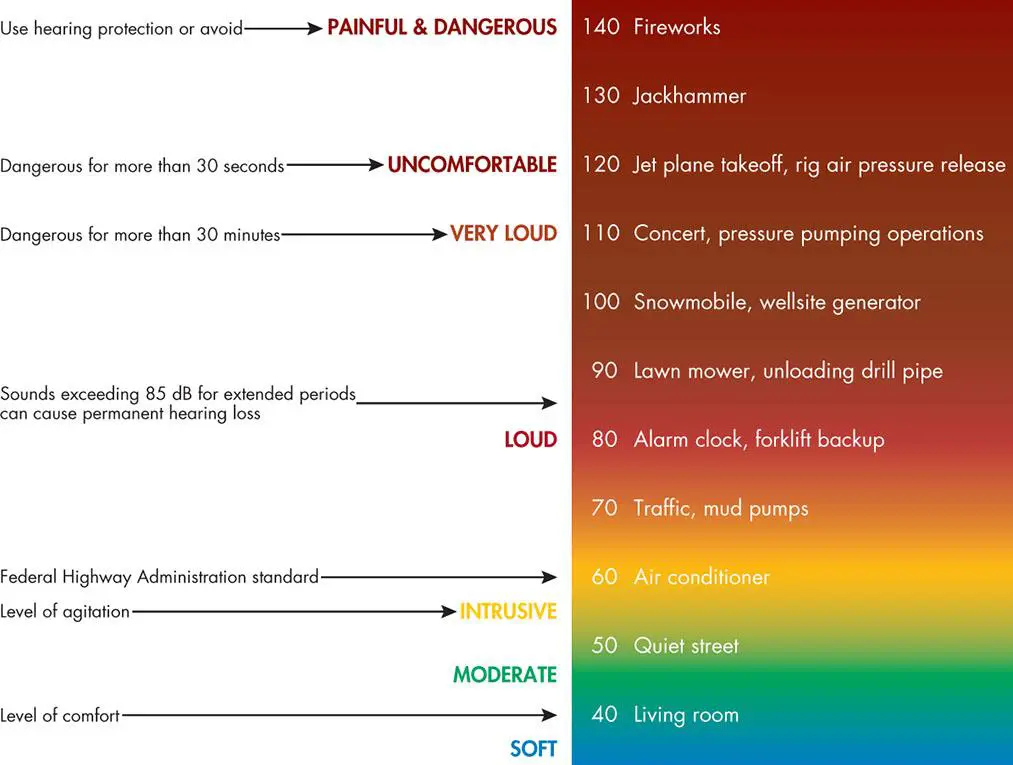
Figure 1. The spectrum of noise levels in decibels (dB), on a relative scale, in well-known situations. Drilling, completion or compressor noise greater than 55 dB at the wall of a residence, commercial or municipal property may create a level of agitation.
Perhaps it’s counterintuitive, but studies have shown that a steady low noise may be more damaging than an infrequent loud noise. Often, manufacturing or construction activities are conducted during normal working hours when a certain amount of noise is more tolerable since people are normally awake and are going about their usual activities so are less likely to be annoyed. If people understand the source, they are able to rationalize the noise and accept it because they know the cause and perceive it is a temporary inconvenience. For example, people living in a new subdivision rarely complain about the sound of carpenters’ hammers as a neighboring home is built. They know that in due time, the sounds will cease, and they also know that it is unreasonable to expect that a house could be built without hammering. Particularly annoying is the beep-beep sound when a truck or bulldozer travels in reverse, but people accept a back-up signal because they appreciate that this warning device saves lives. Consequently, there is a certain level of acceptance for noises considered normal, particularly if they are temporary. On the other hand, a family might find fault with a rock band of teenagers practicing in their neighbor’s garage. This could classify as an unusual noise, often conducted during non-school hours like weekends and evenings, and perhaps one without the promise of concluding.
The fact that noises fall into a large number of classes and categories can result in very subjective reactions from the general public. Who is to say whether a noise source is acceptable or unacceptable What may be music to a proud parent’s ear may be cacophony to a neighbor.
An objective approach solves the problem
Ruling out temporary sources of noise like carpenters’ hammers or the occasional car passing, it is safe to say that commercial activities typically generate the kind and volume of noise that annoys the public. Most companies want to be good neighbors and are willing to take steps to mitigate industrial noises or, if possible, eliminate them. Solutions can be extremely elaborate and costly. For example, when oil companies were developing the Los Angeles field in California, they built soundproofed shell buildings along Sunset Boulevard. From the outside, they looked like typical high-rise office buildings, but they were completely hollow and concealed a full drilling rig. Even passersby on the sidewalk were unable to hear the sounds of pipe clanging, brakes squealing and generators roaring. Service trucks were required to have noise suppression systems so their temporary presence would not overcome the soundproofing. When the rig was through drilling, it was quietly dismantled and hauled off in pieces, but never during rush hour, so they didn’t even add to the principle annoyance of Angelinos—traffic.
Such elaborate tactics to mitigate undesirable sounds may be necessary, especially in
densely populated areas. But what about drilling and production activities conducted
in more traditional locales? This is where a scientific approach can solve the problem
at minimal cost.
Acoustical Consulting Services
Municipal noise ordinances specify maximum allowable noise levels measured at specific distances from noise-generating sources. Without understanding the potential noise impact of specific equipment, operators can waste valuable time and money dealing with compliance. TruHorizon deals with this in two ways:
Noise Measurement and Reporting
Operators can choose from the following services:
- Continuous 24/7 sound level measurement and monitoring
- 24-hour ambient sound level survey
- 72-hour ambient sound level survey
- Compliance sound level survey
- Drilling/fracing/compressor survey
- Equipment/facility survey
Noise Impact Prediction and Modeling
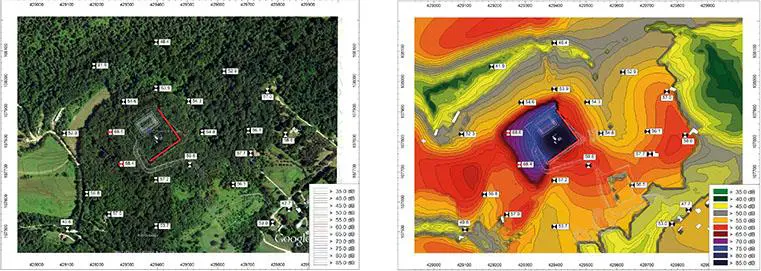
State-of-the-art noise prediction software provides very accurate importation of contour maps with buildings and population centers in place. The software allows inclusion of seasonal parameters along with prevailing wind data. Modeling shows the effectiveness of natural noise barriers such as elevation advantages, dense trees or underbrush that reduce risk and can greatly reduce noise mitigation costs. A site-specific noise management plan is generated with various noise mitigation solutions in place (Figure 2). This allows selection of the most effective solution without costly trial and error.
Leading environmental services companies perform detailed site surveys before any
drilling and production equipment and vehicles are delivered to the site. Starting at
the planned site of the future wellhead, first they identify any homes or public buildings
that may be affected and place them on a detailed contour map of the area. Then, they
ensure they have the most current municipal and state ordinances governing allowable
noise levels. The good news is that 75% of the time, it is found that the proposed
drilling activity will not affect the neighboring populace.
In the remaining 25% of instances where a risk of noise pollution exists, the company
designs a barrier to reduce noise to acceptable levels at each affected building or
residence. In most cases it is not necessary to completely surround the rig site with a
barrier. A directional approach utilizing a partial barrier may result in an acceptable
solution.
The proposed drill site is modeled using noise impact and prediction software that can build a site specific noise management plan and verify its effectiveness. Typical drill site sounds can be emulated and their effect measured with the proposed mitigation media in place to confirm its effectiveness before a single barrier is erected. This eliminates the time- and money-wasting trial-and-error approach that some companies take. The model considers the effects of differences in elevation, intervening trees and underbrush, the direction and intensity of the prevailing winds and seasonal considerations. For example, a leafy maple tree may make a great natural sound barrier in summer but not in winter after the leaves have fallen. An existing babbling brook or waterfall may help mask sounds that could reach a built-up area if those features were absent. All such factors are accounted for by the software modeling program.
The result of the modeling is a recommended design for noise mitigation to acceptable levels. Operators can choose permanent or temporary barrier solutions depending on their needs. After the sound mitigation system is erected, the environmental services company may monitor noise levels for 24- or 72-hour periods to evaluate the barriers’ effectiveness. A compliance noise level survey can be produced from this data to submit to regulatory authorities, if necessary.
Sometimes, a linear barrier between the drill site and the nearest population center is all that is required. For temporary mitigation of sound during a hydraulic fracturing operation, for example, additional temporary barriers can be deployed to augment existing barriers. In other cases, such as at a continually operating compressor station, erecting a complete enclosure may prove to be the appropriate action to take.
Noise Mitigation Services
Drilling/fracing sites
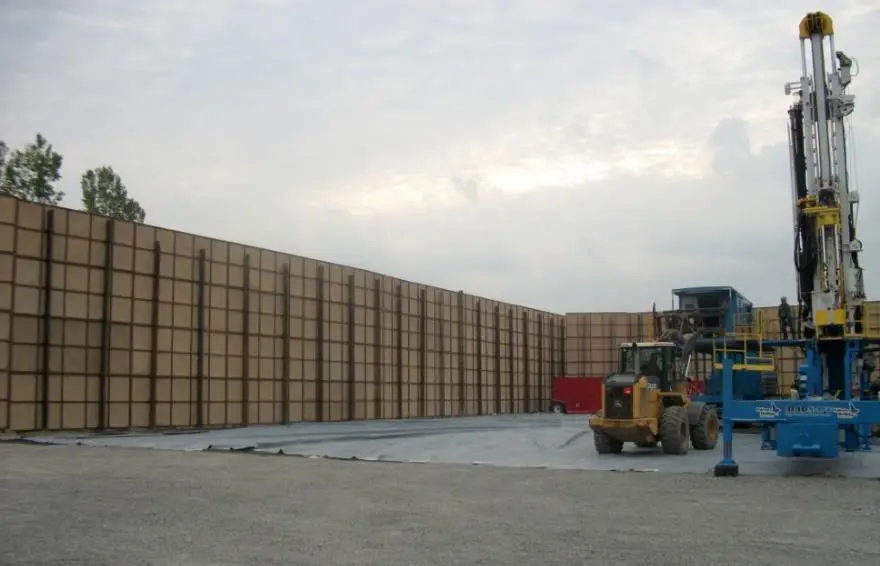
Drilling operations are usually temporary. Nonpermanent sound barriers have proven effective
in mitigating noise impact within sensitive surroundings. Modular systems can be easily taken
down and reconfigured to fit the next drill site that needs them. Most installations are completed
in less than one day (Figure 3).
Compressor stations/production sites
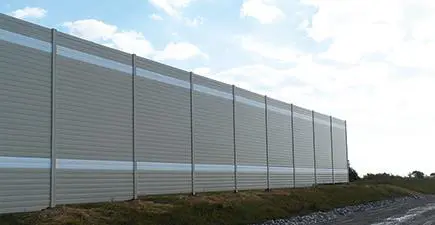
Production operations can last for several years. Accordingly, their noise barriers are designed
to be more permanent. Where possible, complete enclosures are recommended for two reasons:
first, by enclosing the equipment, sound is mitigated in all directions, allowing for future
buildings or homes to be constructed nearby without having to revise the design; second, an
enclosure acts as a barrier to vandalism or severe weather (Figure 4).
Typical barriers fall into two categories: reflective and absorptive. As their names imply, each mitigates sound by either reflecting it away from built-up areas or deadening the sound through absorption. The barrier media is modular to facilitate transportation and erection. This feature also allows barrier modules to be relocated to other sites where they can be configured to manage sound from that location according to that location’s predictive model and site survey.
It has been proved many times that a proactive approach that anticipates and mitigates annoyances before they occur is the hallmark of a good neighbor policy. Companies that engrain good neighbor practices into their culture build strong, positive reputations that can weather the occasional complaint. Most fair-minded citizens are willing to give the benefit of the doubt to enterprises that demonstrate they are keen to be good neighbors by taking positive steps to engender good relationships from the beginning with those who live and work around their facilities and operations.

M3 Noise Solution™
In the oilfield, TruHorizon helps you be a good neighbor by first measuring and modeling the potential for noise pollution and then engineering solutions that mitigate noise from a level of agitation to a level of comfort.
- Measure: Ambient sound levels are recorded prior to site construction.
- Model: Rig and equipment sound signatures from a proprietary noise library
are used to build a predictive sound model before the wellsite is built or
equipment is deployed. The model is used to optimize layout to minimize noise. - Mitigate: If needed, appropriate sound suppression technologies are designed
and implemented.